Markets
Stock market basics: what you are actually buying
Almost every confusing thing about the stock market becomes simple once one sentence is properly absorbed: a share is a slice of a company. Not a ticket, not a bet on a number, not a thing whose price is its identity.
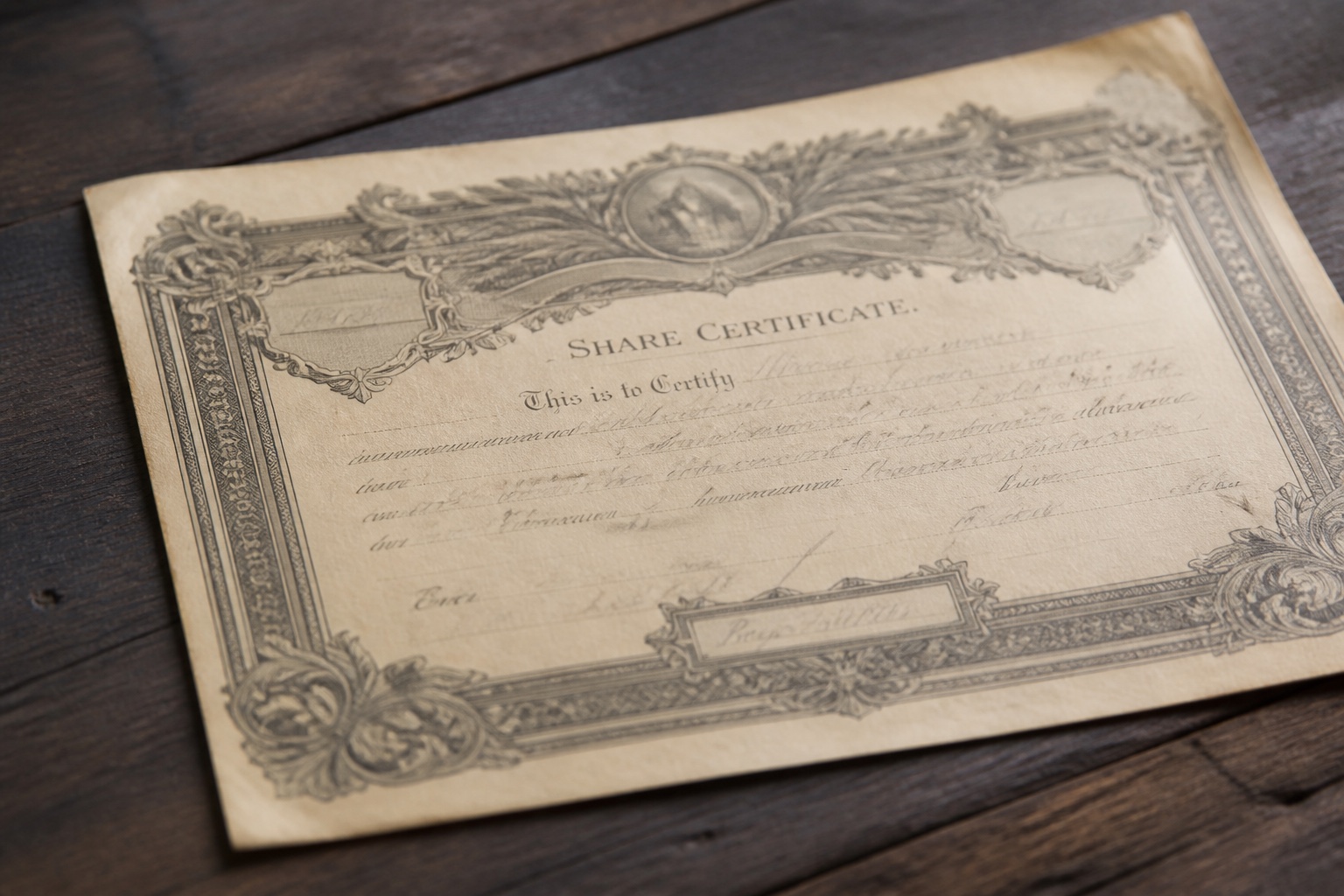
A company that wants money for something expensive has two options. It can borrow, promising to repay on a schedule, which produces a bond. Or it can sell part of itself, giving up a share of everything it will ever earn, which produces a share. That is the entire origin of the stock market. Everything else is plumbing built on top of those two sentences.
What one share actually is

Ownership, divided. If a company has issued 10 million shares and you hold 100 of them, you own one ten thousandth of one percent of that company. That is not a metaphor. You own that fraction of its buildings, its contracts, its brand and its future profits, and you are entitled to that fraction of anything it chooses to distribute.
Two rights come with it in most cases. A claim on distributed profits, paid as dividends when the company decides to pay them. And a vote, proportional to your holding, on certain company decisions. For a small holder the vote is arithmetically irrelevant, but its existence is the proof that a share is ownership rather than a wager.
It also comes with a limit worth stating: if the company fails, shareholders are last in the queue, behind lenders and suppliers. That is the trade. Owners get the upside without a ceiling, and they get wiped out first.
Why the price of a share tells you nothing
This is the most common beginner misunderstanding, and it is worth killing early. A share priced at 5 is not cheap and a share priced at 500 is not expensive. The price of a single share is the size of the slice, not the size of the cake.
Two companies, same value, different share prices
- Company A: 10,000,000 shares at $40 $400,000,000
- Company B: 400,000,000 shares at $1 $400,000,000
- What 100 shares of Company A represents 0.001%
Multiplication only, using invented companies to isolate the arithmetic. Price per share multiplied by the number of shares gives the market value, and neither figure means anything without the other. No real company is referred to here and nothing is recommended.
The figure that describes size is market capitalisation: the share price multiplied by the number of shares in existence. Once you have that habit, a whole genre of bad reasoning becomes visible, starting with the belief that a low priced share has more room to rise.
Where a price comes from

A quoted price is the record of one transaction: the amount the most recent buyer and the most recent seller agreed on. It is not an appraisal, and nobody calculated it. It is the price at which the last disagreement about value got resolved.
That has a consequence that surprises people. Prices move on changes in expectation, not on events. A company can announce excellent results and fall, because the price already contained an assumption of excellent results and the announcement was slightly less excellent than assumed. When commentary says a market fell because of some piece of news, it is usually a story fitted to a movement after the fact.
The two markets, and which one you are in
Beginners often assume that buying shares sends money to the company. Almost always, it does not.
- The primary market is where a company issues new shares and receives the proceeds. It happens rarely in the life of a company, and ordinary investors are usually not part of it.
- The secondary market is everything else, and it is where essentially all trading happens. You buy from another investor who wants out. The company receives nothing and is not involved in the transaction.
The secondary market still matters to the company, because a functioning resale market is what makes anyone willing to buy in the first place. The technical word for that is liquidity, and it is the service an exchange actually provides.
The two sources of return
Only two things can make a shareholding worth more to you than what you paid.
| Source | Where it comes from | Certainty |
|---|---|---|
| Price change | Someone later willing to pay more than you did | None whatsoever |
| Dividends | Profit the company chooses to distribute to owners | Discretionary and reducible at any time |
Add them together and you have total return, which is the only version worth comparing. A holding that rose 4 percent and paid 3 percent produced more than one that rose 6 percent and paid nothing, and looking only at the chart hides that entirely.
Notice that neither source is promised. This is the structural difference between a share and a savings account, and it is the reason the two are used for completely different jobs, as set out in saving and investing are two different jobs.
What the stock market is not
Four confusions worth clearing, because each one produces a recognisable bad decision.
- It is not the economy. A market index is a weighted list of particular listed companies, which is a narrow and unrepresentative slice of any country. The two can move in opposite directions for years without either being wrong.
- It is not a scoreboard of quality. Prices reflect expectations relative to what was already assumed. A superb company at a demanding price can disappoint; an unremarkable one at a low price may not. This is the argument underneath value and growth investing.
- It is not a place where activity is rewarded. Every trade costs something, in spread if not in commission, and frequent trading multiplies those costs against a balance that was supposed to be compounding.
- It is not somewhere that money you need soon belongs. Prices can be lower on the specific day you need cash, which is precisely why the buffer comes first.
What it is, on a long enough view, is a mechanism for owning productive things without running them yourself. That is a genuinely useful thing to be able to do, and it is quite different from what the daily coverage suggests it is.
- Exchange
- The venue where buyers and sellers are matched, with published prices and settlement rules. It sets no prices itself.
- Ticker
- A short code identifying a listing on a particular exchange. The same company can carry different codes in different countries.
- Spread
- The gap between the price you could sell at and the price you could buy at, at the same moment. A real cost that never appears on a statement.
- Volume
- How many shares changed hands in a period. High volume means the price was tested by many transactions rather than a few.
Common questions
Do I own part of a company if I hold a fund?
Indirectly, yes. A fund holding shares owns those shares, and you own a proportional slice of the fund. The voting rights normally sit with the fund rather than with you, and the practical effect is that you hold a small piece of many companies at once.
Why do prices move when nothing has happened?
Because prices move on expectations, and expectations change continuously as people reassess what they already knew. Days with no news are not days with no reassessment.
Is a falling share price a signal to buy?
It is not a signal of anything by itself. A lower price means the last transaction happened lower; it says nothing about whether the future changed by more or less than the price did. This site does not tell anyone what to buy, and treats any rule of that shape with suspicion.
How many companies do I need to hold?
Enough that no single one can decide your outcome, which is the whole argument in diversification explained. For most beginners that is achieved by holding a broad fund rather than by assembling individual companies.
This is a general explanation of how shares and share prices work. It contains no view on any company, market or price, no recommendation to buy or sell, and the two companies used in the arithmetic above are invented to isolate a calculation.